
Arabian Canal Project in Dubai
The Arabian Canal was envisioned as a monumental man-made waterway reshaping the southwest of Dubai in the United Arab Emirates. Construction began in 2008, but the project has been on hold since 2009 due to Dubai’s financial situation at the time.
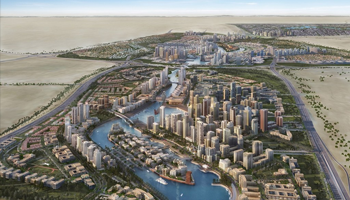
The scale of the plan was extreme even by Dubai standards: a 75 km artificial canal, a new urban region of roughly 140 square kilometers around it, dense high-rise clusters built along sculpted waterfront landforms, and housing capacity projected for around 1.5 million people. The total project cost for the canal alone was estimated at 11 billion USD.
This article explains the original concept, the planned engineering and urban design, what was actually built before the pause, and the main criticisms raised about feasibility and long-term viability.
Concept and Route
The Arabian Canal was planned to start from the coast as part of the Dubai Waterfront area. From there, it would curve inland to the south, loop across the desert for about 75 km in total length, and then turn back north to discharge into the Persian Gulf.
The intended outlet point was on the Gulf west of Dubai Marina, between the high-rise coastal development zones and a seawater desalination facility. The route was not a straight cut. It was designed as a sweeping, meandering path with several lateral deviations and basin-like widenings, creating an artificial shoreline for future development.
Key high-level elements of the route plan:
- Total canal length: ~75 km.
- Canal loop: inland first (south), then curving back north to reach the Gulf.
- Return to the Gulf: west of Dubai Marina.
- Integration with Dubai Waterfront and other planned megaprojects.
- Surrounding development footprint: ~140 km² of reclaimed, graded, or elevated land.
Planned Urban Development Around the Canal
Population Density and Land Use Strategy
The developer, Limitless, projected that approximately 1.5 million residents could ultimately live in the canal corridor. Hitting that number required aggressive vertical density. The plan relied on “punctual” high-rise clusters rather than uniform sprawl, with multiple secondary urban centers along the canal.
- Estimated resident capacity: ~1.5 million people.
- Developed land area referenced: ~140 km².
- Approach: concentrated high-rise zones around selected subcenters rather than low-density housing everywhere.
The canal edges and adjacent uplands were meant to become premium real estate. The design intent was not only to create new waterfront parcels, but to shape artificial slopes, terraces, and view corridors so that buyers could choose direct water access, elevated “water view” lots, or stepped terraces.
Waterfront Geometry and Marketing Logic
The project was not primarily about freight transport. Instead, it was a landscape product.
- Canal width: typically 75 m to 150 m.
- Canal depth: around 6 m.
- Lock system: none planned — the canal was designed without locks.
- Navigation class: small to mid-size private boats, not commercial shipping.
Along the edges, the plan called for gently curving banks, lagoon-like widenings, and sculpted shorelines with a stated 33 km of direct waterfront edge ready to be sold. Much of that waterfront mileage was associated with the southern crosscut portion of the canal alignment.
The positioning was straightforward: Dubai would create thousands of new waterfront and near-waterfront parcels in the interior desert, using engineered water as an amenity — the same logic behind offshore artificial islands and coastal land reclamation. The canal was, in effect, a lifestyle and real estate machine.
Vertical and Topographic Design Features
Beyond flat plots, the masterplan included:
- Raised embankments and terraced slopes.
- Stepped build zones and bowl-like escarpments.
- Sculpted “hills” where earth from excavation would be piled, in some cases up to ~200 m high.
- Uplifted lots that overlook the water from above rather than sitting directly at canal level.
Some parcels were even described as “exposed” lots on steep edges, suggesting premium dramatic siting rather than uniform marina-style moorings.
Engineering Highlights
Canal Dimensions and Navigation Envelope
The canal cross-section was engineered wide enough and deep enough to allow pleasure craft and mid-size boats.
- Target width: 75 m to 150 m.
- Target depth: ~6 m.
- Target vessel length after flooding: boats up to ~60 m.
This made the Arabian Canal more of a navigable leisure waterway than an industrial shipping route.
Tunnel Section
One technical highlight in the original concept was a tunnel segment in the canal’s southwestern run. Over a span of roughly 900 m, the canal would pass under a small natural or man-made elevation barrier. This is unusual for an inland artificial canal, where open-cut is typically cheaper; here, visual continuity of the elevated landscape was part of the sales pitch.
Bridges and Crossings
The plan called for “numerous landmark bridges,” plus rising embankments and terraced grades to create visual drama. The bridges weren’t just transport infrastructure; they were meant as skyline features anchoring subdistricts.
Excavation and Earthworks
The excavation requirements were enormous:
- Total projected excavation for the full canal: >1 billion cubic meters of soil.
- Reuse strategy: the removed earth would be redeployed locally to form artificial hills, terraces, and developable plateaus.
- Individual early test cut (October 2008): ~700 m long, ~200 m wide, up to ~45 m deep. That test section alone moved more than 1.5 million cubic meters of material.
Later, a first awarded construction package covered about 9 km of canal length. That segment alone would require on the order of 200 million cubic meters of excavation.
Project Timeline and Costing
Bidding and Early Works
- Late July 2008: first bid offer was submitted for an initial canal section.
- October 2008: trial excavation took place (700 m x 200 m x up to 45 m deep).
- Late September 2008: a contract was awarded for the first official canal phase, valued at 2.1 billion USD.
That first major package focused on a ~9 km stretch of canal, with immediate surrounding land prepared for urbanization.
Urbanization Triggered by Phase One
The idea was highly iterative. As soon as each section of the canal trench and adjacent grading was complete, that land would be released for development.
- First-section buildout footprint: ~2,200 hectares of canal-adjacent land.
- Initial capacity projection: housing for roughly 600,000 people in just that first zone.
- Strategy: excavate, shape, flood, market, build — all in parallel rather than waiting for the entire 75 km to be finished.
Macro Budget and Delivery Horizon
- Estimated total canal cost: ~11 billion USD.
- Original schedule for just the canal civil works: completion by 2013.
- Additional timeline for full urban buildout of shores, uplands, and islands: ~15 more years beyond canal completion.
In other words, the original vision stretched decades. The expectation was a rolling city-building process continuing well past the initial infrastructure phase.
Financial Shock and Project Pause
After work began in 2008, Dubai was hit by a financial crisis in 2009. As a result, the Arabian Canal was effectively put on hold.
Because of that pause, the 2013 completion target for the waterway itself did not materialize as planned, and the 15-year long-term urbanization roadmap no longer matched reality. The project remains suspended.
Technical and Environmental Concerns
Water Quality and Circulation
A recurring criticism focused on water movement in inland stretches of the canal. Since the Arabian Canal was not fed by any natural river system and relied entirely on seawater intake from the Gulf, experts warned about stagnant water in interior segments.
The concern was straightforward:
- The farther inland you go, the weaker the natural exchange with the Gulf.
- Without locks, pumps, or additional inlets feeding circulation, some basins risked becoming still water bodies.
- Stagnant saltwater in a hot desert climate raises obvious quality, odor, and ecological issues for long-term residential appeal.
Sustainability Positioning
The project was marketed as landscape engineering with lifestyle value — sculpted water, shaped terrain, controlled views. It did not claim to be primarily about freight logistics, stormwater management, or regional hydrology.
Instead, the canal acted as a real estate catalyst. This “real estate first, infrastructure second” posture drew both interest (for its ambition) and criticism (for its environmental and financial risk profile).
Status as of 2025
Key facts:
- Groundworks began in 2008.
- Major excavation packages were awarded and early test cuts were dug.
- By 2009, after the financial downturn in Dubai, the project was paused.
- The canal in its originally announced form is still not delivered.
Because the Arabian Canal was conceived as an integrated land creation + city-building program rather than a standalone utility, the pause froze not only the waterway but also the entire surrounding urban vision: bridges, high-rise clusters, artificial hills, waterfront parcels, and targeted housing for hundreds of thousands of residents in each segment.
At this point, the Arabian Canal stands as one of Dubai’s most ambitious unrealized megaprojects — structurally designed, partially initiated, but never brought to full execution under the original timeline.
FAQs
Was the Arabian Canal supposed to be navigable for commercial shipping?
No. The canal depth (about 6 m) and intended vessel profile (boats up to roughly 60 m in length after flooding) point to leisure craft and private marine circulation, not heavy cargo.
How many people was the development supposed to house?
The full canal corridor was projected to support about 1.5 million residents across ~140 km² of new and reshaped land. The very first 9 km segment alone was pitched as housing for around 600,000 people once urbanized.
Why did the project stop?
The global financial crisis hit Dubai in 2009. Funding and development appetite dropped, and the Arabian Canal — which depended on constant capital input and land sales to finance each next section — was put on hold.
What were the main engineering challenges?
Three standouts:
- Massive excavation volume (over 1 billion cubic meters total projected).
- A planned tunnel section where the canal would pass under a raised land barrier for ~900 m.
- Long-term water circulation inside inland basins, since the canal had no natural freshwater inflow.
Currently viewing
Arabian Canal Dubai project
Burj Azizi: Dubai’s Second-Tallest Building
Dubai continues to push the boundaries of architectural innovation with the Burj Azizi, a skyscraper…
Modular Architecture Innovation Design
Architectural Innovation Through Modular Design The construction industry faces mounting pressures: housing shortages in growing…

Choosing Structural Materials
Timber, Steel, and Concrete: Choosing the Right Structural Language Every building begins with a fundamental…

Green Facades & Sustainable Materials
Green Facades & Sustainable Materials: The Future of Urban Skins Buildings shape the visual and…

Adaptive Reuse
Adaptive Reuse: How Old Buildings Shape Modern Urban Life Cities are living archives. Every structure…

The Rise of Smart Architecture
The Rise of Smart Architecture: Designing the Intelligent City [2025] The architectural landscape is undergoing…

Time Residences in Dubai to be ‘Green’
Time Residences in Dubai to be ‘Green’ Updated: 27/10/2025 When Dubai announced Time Residences in…

