
Time Residences in Dubai to be ‘Green’
Updated: 27/10/2025
When Dubai announced Time Residences in November 2006, the architectural world took notice. This wasn’t just another luxury tower—it was the world’s first fully rotating «timepiece» skyscraper designed to move with the sun while championing genuine sustainability. Conceived by celebrated architect Glenn Howells for the City of Arabia district within Dubailand, the 30-story cylindrical tower promised residents a home that literally evolves throughout the week, powered entirely by solar energy.
The concept was revolutionary: a building completing a full 360-degree rotation every seven days, delivering ever-changing panoramas without the massive energy costs typically associated with kinetic architecture. Every apartment would experience constantly shifting views of water features and landscaped vistas, all while the building’s climate-responsive design slashed cooling loads in Dubai’s punishing heat.
Time Residences represented more than architectural theater. It proposed a future where sustainability drives everyday luxury—where smart skins, passive systems, and solar-powered motion combine to create homes designed not to age. The tower’s dual-skin «breathing» façade, recycled water systems, and flexible interiors positioned it as a case study in performance-driven design.
Though construction was slated to begin in June 2007 with completion targeted for Q1 2009, the project offers enduring lessons for architects, developers, and sustainability advocates seeking to merge kinetic innovation with livable, energy-efficient design.
The Kinetic Architecture Concept
Time Residences pioneered a bold premise: why should buildings remain static when they can adapt to their environment? The tower’s defining feature—a complete 360-degree rotation every seven days—was powered entirely by solar energy, eliminating the environmental penalty of conventional kinetic structures.
This slow, continuous motion served a dual purpose. Residents experienced constantly evolving views without losing the sense of stability crucial to residential comfort. Meanwhile, the rotation optimized solar exposure and natural ventilation patterns across the building’s envelope, supporting the passive cooling strategies embedded in the façade design.
Howells described the concept as «a revolutionary new way of living in Dubai,» where calm, flexible interiors meet sweeping city views through floor-to-ceiling glazing. The kinetic element wasn’t a gimmick—it was an integral component of the building’s environmental performance strategy.
Climate-Responsive Dual-Skin Façade
Dubai’s extreme heat demands architectural solutions that go beyond standard glass curtain walls. Time Residences answered with a dual-skin «breathing» façade system designed to balance thermal performance with visual connection.
Outer Gold Screen Layer
The exterior layer featured delicately patterned gold screens that filtered glare and radiant heat before it reached the building’s interior. These screens balanced reflectivity, depth, and transparency—creating visual interest while serving as the first line of defense against solar gain.
Inner High-Performance Glass
Beneath the gold screens, layers of high-performance, neutrally coated glass stabilized indoor comfort. This inner skin preserved daylight and views while working in concert with the outer screen to dramatically reduce cooling loads. The air cavity between layers allowed heat to dissipate through natural convection, a passive strategy that reduced reliance on mechanical systems.
The façade’s textural, light-modulating design was selected as much for thermal performance as aesthetic poise—properties «designed not to age» that would deliver cool, quiet apartments over decades of operation.
Architectural Form and Structure
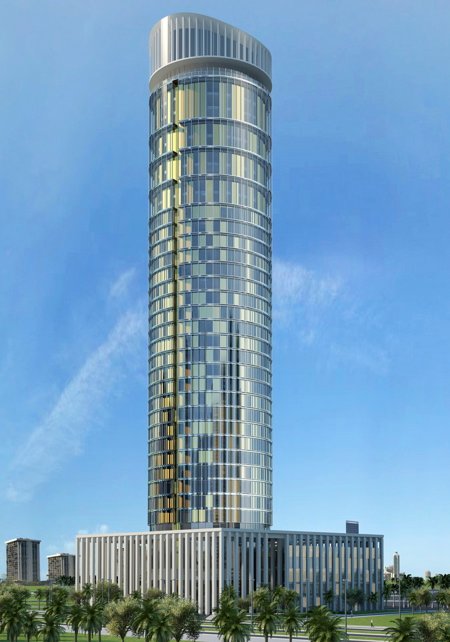
Time Residences’ cylindrical 30-story form wasn’t arbitrary—it maximized the effectiveness of the rotation mechanism while optimizing views and structural efficiency.
A 20-meter-tall horizontal podium grounded the tower, providing visual weight and housing shared amenities. At the crown, an elegant crescent framed the kinetic silhouette, creating architectural anchors that balanced the building’s dynamic nature with compositional stability.
The circular plan reduced structural complexity compared to rectilinear rotating designs while eliminating awkward corners. Every millimeter of the perimeter contributed to the resident experience, with no «dead» façade areas or service cores interrupting the relationship between interior and exterior.
Residential Layouts and Interior Design
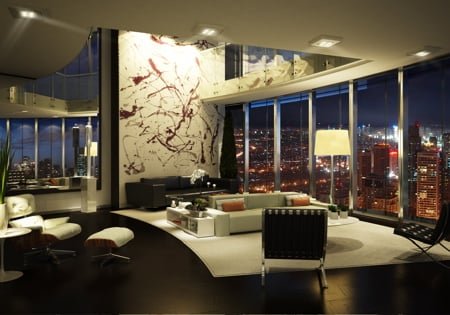
Time Residences housed approximately 200 apartments ranging from generous one-bedroom layouts to expansive four-bedroom homes. The unique segment-shaped floor plans hugged the building’s circular perimeter, maximizing external awareness and delivering broad, cinematic views.
Flexible Living Zones
Sliding screens allowed residents to expand or compartmentalize living areas on demand. Need a private home office? Close the screens. Hosting guests? Open everything for a flowing entertainment space. This adaptability enhanced privacy for work, rest, or entertaining without sacrificing the sense of openness crucial to luxury living.
Signature Triplex Penthouses
At the tower’s upper levels, triplex penthouses pushed the envelope further with double-height living spaces, private infinity pools, and state-of-the-art home cinemas. These features transformed a skyline address into a personal retreat—demonstrating how vertical living could deliver single-family-home amenities at elevation.
The floor-to-ceiling glazing throughout all units ensured unobstructed views, while the constantly rotating building guaranteed that no two days felt identical from the same apartment.
Integrated Green Systems
Time Residences’ environmental credentials extended well beyond its solar-powered rotation. The project incorporated multiple strategies to reduce resource consumption in Dubai’s desert climate.
Water Conservation
Recycled water was slated to irrigate the surrounding landscape gardens, dramatically reducing potable water consumption. In a region where water scarcity remains a persistent challenge, this closed-loop approach demonstrated how luxury developments can minimize their ecological footprint without compromising aesthetics.
Passive Cooling Strategies
The dual-skin façade’s passive strategies—shading, ventilation between layers, and selective reflectivity—worked synergistically with the cylindrical form to lower cooling demand. By reducing the building’s baseline energy requirements, these systems made solar power viable for both rotation and partial building operations.
Solar Energy Integration
The tower’s solar arrays powered the rotation mechanism while contributing to general building loads. This integration proved that kinetic architecture could be self-sustaining rather than energy-intensive—a critical distinction for projects claiming environmental leadership.
Amenities and Community Spaces
Beyond private residences, Time Residences offered carefully curated shared spaces that took advantage of the building’s unique characteristics.
Outdoor Pool Deck
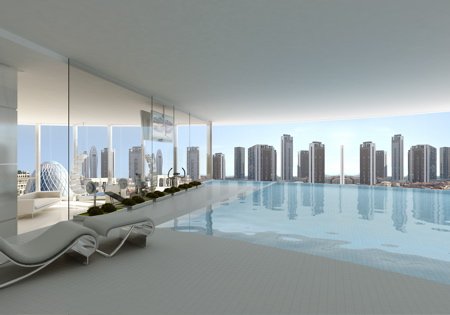
The pool deck captured constantly changing perspectives of Dubai’s skyline as the building rotated. What might feel static in a conventional tower became a dynamic experience—sunset views shifted throughout the week, ensuring visual novelty for regular users.
Fitness Center
A fully equipped gym served residents prioritizing wellness, with equipment positioned to take advantage of the rotating views. Early morning workouts and evening sessions offered distinctly different visual experiences without changing floors.
Moon Lounge
The crown jewel: a sky-high «Moon Lounge» designed for social gatherings set against Dubai’s evolving skyline. This aerie represented more than a club room—it embodied the project’s promise of elevated living where architecture, community, and environment converge.
Location Within City of Arabia
Time Residences was positioned in the City of Arabia district within Dubailand’s vast master plan. This location plugged the tower into a broader destination known for attractions, retail, and leisure infrastructure.
The site selection balanced access to urban amenities with the space required for the tower’s landscaped grounds and water features. City of Arabia’s master plan complemented Time Residences’ vision of sustainable luxury—creating a neighborhood where environmental performance and cosmopolitan living could coexist.
Project Timeline and Development Context
Announced in November 2006 during Dubai’s development boom, Time Residences reflected the era’s appetite for architectural innovation. Construction was expected to begin in June 2007, with completion targeted for the first quarter of 2009—an aggressive 21-month timeline that underscored developer confidence in bringing kinetic-sustainability concepts to market.
The project emerged during a period when Dubai positioned itself as a global architecture laboratory. Time Residences joined a constellation of ambitious towers pushing boundaries in form, height, and technology—though few matched its integration of movement, solar power, and passive environmental design.
Glenn Howells’ Design Philosophy
Architect Glenn Howells approached Time Residences as an opportunity to demonstrate that sustainability and luxury aren’t opposing forces. His design philosophy centered on creating buildings that perform as well as they appear—where every aesthetic decision contributes to environmental outcomes.
The project’s layered, textural envelope; the flexible interiors; the solar-powered kinetic element—each represented Howells’ conviction that thoughtful design solves problems while enhancing human experience. Time Residences embodied his belief that the best architecture delivers both immediate delight and long-term value without requiring occupants to compromise comfort for conscience.
Technical Innovation in Kinetic Design
Rotating an entire 30-story residential tower every seven days presents extraordinary engineering challenges. The mechanism must be whisper-quiet to avoid disturbing residents, perfectly balanced to prevent vibration, and energy-efficient enough to run on solar power.
Time Residences addressed these requirements through careful weight distribution, advanced bearing systems, and the cylindrical form that simplified rotation dynamics compared to irregular shapes. The seven-day cycle was slow enough to be imperceptible to occupants while fast enough to deliver meaningful view variety throughout the week.
This technical achievement separated Time Residences from earlier rotating restaurant concepts—proving that kinetic architecture could scale to full residential buildings without creating unacceptable noise, vibration, or energy consumption.
Sustainability Metrics and Performance Goals
While specific energy reduction targets weren’t publicly detailed, Time Residences integrated multiple strategies that collectively aimed to reduce building energy consumption compared to conventional luxury towers:
- Passive cooling through dual-skin façade reducing HVAC loads
- Solar energy generation powering rotation and partial building systems
- Water recycling minimizing potable water use for irrigation
- Optimized orientation through rotation maximizing natural ventilation opportunities
- High-performance glazing reducing solar heat gain while preserving views
The project proposed that buildings could move beyond neutral impact toward active environmental stewardship—where design decisions compound into meaningful resource savings over decades of operation.
Impact on Sustainable Architecture Discourse
Time Residences contributed to evolving conversations about what «green building» means in luxury contexts. Rather than treating sustainability as an afterthought or marketing angle, the project integrated environmental performance as a core design driver from inception.
The tower challenged the assumption that sustainability requires aesthetic compromise or reduced comfort. Its dual-skin façade was beautiful and thermally efficient. The kinetic element was both spectacular and functional. The flexible interiors delivered adaptability without sacrificing luxury.
This holistic approach influenced subsequent projects seeking to merge environmental credentials with high-end residential experiences—demonstrating that smart design solves multiple problems simultaneously.
FAQs
How fast does Time Residences rotate?
The tower completes a full 360-degree rotation every seven days—slow enough to be imperceptible to occupants while ensuring constantly evolving views throughout the week.
What powers the rotation mechanism?
Solar energy panels integrated into the building’s design power both the rotation mechanism and contribute to general building operations, eliminating the energy penalty typically associated with kinetic architecture.
How does the dual-skin façade work?
The outer layer features gold screens filtering glare and heat, while the inner high-performance glass stabilizes interior comfort. The air cavity between layers dissipates heat through natural convection, reducing cooling loads.
How many apartments does Time Residences contain?
Approximately 200 residences ranging from one-bedroom layouts to four-bedroom homes, plus signature triplex penthouses with private pools and cinemas.
Where is Time Residences located?
The tower was planned for the City of Arabia district within Dubailand’s master plan in Dubai, UAE.
Who designed Time Residences?
Celebrated architect Glenn Howells conceived the project, integrating kinetic architecture with climate-responsive design strategies.
What makes the building «green»?
Beyond solar-powered rotation, the tower incorporates recycled water for irrigation, passive cooling through its dual-skin façade, high-performance glazing, and flexible interiors designed for long-term adaptability.
Currently viewing
Time Residences in Dubai to be ‘Green’


Structural Integrity & Materials Science
Structural Integrity & Materials Science: UHPC, FRP & ROI Materials science is experiencing a revolution…

AI in construction
AI in Construction: Applications, ROI & Real Results The construction industry has historically lagged behind…

Engineering the Sustainable City
Engineering the Sustainable City Cities stand at a crossroads. While occupying just 3% of Earth’s…
Waterproofing Technologies
Waterproofing Technologies Waterproofing represents the most underestimated yet critical component of any construction project. Despite…
Retrofitting Urban Infrastructure
Retrofitting Urban Infrastructure Cities worldwide face a critical challenge: vast portions of their building stock…
Energy Systems for Smart Buildings
Energy Systems for Smart Buildings The term «smart building» has become ubiquitous in commercial real…

The Future of Structural Systems
The Future of Structural Systems: Innovation & Trends The construction industry stands at an inflection…
Arabian Canal Dubai project
Arabian Canal Project in Dubai The Arabian Canal was envisioned as a monumental man-made waterway…

Dubai Industrial City warehouses for lease
Dubai Industrial City warehouses for lease Updated: 27/10/2025 Dubai Industrial Park Dubai Industrial Park (formerly…

